The Data Warrior

Changing the world, one data model at a time. How can I help you?

Archive for the tag “Data Modeling”

ODTUG KScope12: Day 3 Recap. More Fun in the San Antonio Sun

Well it was another HOT day in San Antonio, Texas at the 2012 ODTUG KScope conference.

Really.. it was.

It was something like 104 degrees outside with a Heat Index of 107.

Yikes.

But it was more like 65 degrees in the session rooms.

They do like to keep it cold inside here in Texas.

But the topics and speakers were hot anyway.

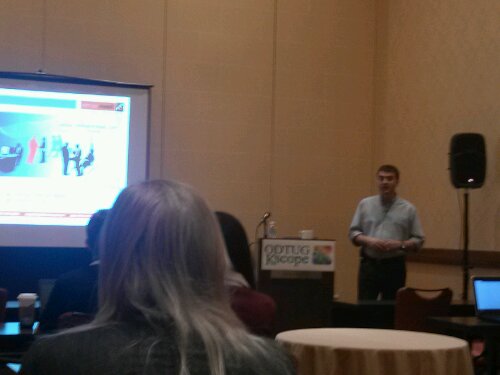
After an energizing session of Chi Gung this morning, my first session to attend was Mark Rittman talking about Exalytics and the TimesTen in-memory database. Based on the number of people in the room at 8:30 AM, I would call this a hot topic for sure.

Inquiring minds want to know if this Exalytics stuff is all it is cracked up to be (and worth the $$).
image

Mark did his best to give us the low down, candid truth. Mostly it was good news.

With the Summary Advisor, it is pretty easy to create an In Memory Adaptive Data Mart which will hold commonly used aggregates. It leverages the existing Aggregate Assistance Wizard,

So what you ask? Well that technology tracks all the quesries run in your OBIEE server and figures out which summaries would help speed up your performance.

Now you won’t get your entire data warehouse up in memory, but you will get the most used data set up to return faster.

The biggest gotcha is that it does not know from automatic incremental refreshes, so you have to use ODI or some scripting to refresh the TimesTen database automatically.

Anyway, the future does look bright for Exalytics.

Next up was Ashley Chen, Oracle Product Manager, talking about the new features in the 3.1 release of SQL Developer and SQL Developer Data Modeler.

Notably in SQL Developer there is now some APEX Integration and TimesTen integration, along with improved DB Copy and DB Diff utilities. Plus they have re-done the Oracle web site for SQL Dev to segment the tool into more logical groupings of functionality.

On the Data Modeler side, new features include Easy Sync to DB, better versioning support, a better, modifiable meta data reporting engine, and the new Query Builder for developing and testing the code for an Oracle view (I wrote about that here).

Then it was bit of a break while I interviewed JP Dijcks in the ODTUG Social Media Lounge and then got my set of ODTUG tatoos.

Next it was lunch and the Oracle ACE and ACE Directors Lunch and Learn sessions where we divided the rooms by topic area and had the various Oracle ACEs answer questions and lead a discussion about topics in their area. Here are a few of the BI ACEs plotting their strategy for the panel.
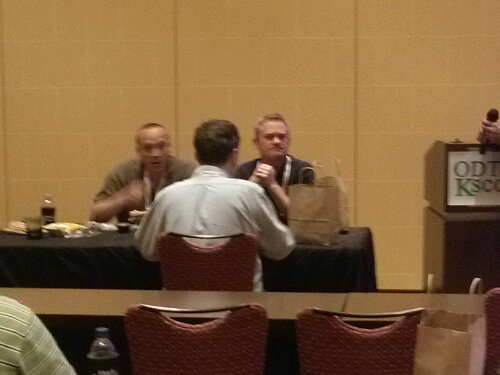
They did end up asking me to join the panel, so I got to field a few questions about data modeling, big data, and where to build a metrics model in the OBI RPD or the database? It depends….

After lunch I attended Ron Crisco’s talk about Agile and Data Design. A favorite topic of mine!

Often a contentious topic, Ron challenged us with some very good questions:

  • Is Agile the enemy of good design?
  • What is data design?
  • Who does it?
  • How do you keep it in sync with ongoing changes and implementation?

He kept this all in context of the principles in the Agile Manifesto and the goal of delivering useful software to the business.

Best quote: “Agile is an Attitude”

I completely agree!

I finished the day hanging out with the Ashley Chen and Jeff Smith in the Data Modeler lab session as folks tried out the new features on a pre-configured Oracle VM.

Ashely and Jeff kept busy helping folks while I tried to get the new VM running on my laptop. No luck. Maybe tomorrow.

I did get to help a bit and answer a few questions for some of the participants.

No official KScope events tonight so I got to spend a little time relaxing by the pool and in the lazy river with my friend JP and his family. Saw several other friends and collegues as well with their spouses and kids playing in the pool. Then we all got to watch Despicable Me projected on a sheet on the far side of the pool.

Pretty neat. Nice way to end the day.

Tomorrow should be another exciting day of sessions and then we have the BIG EVENT:  we all saddle up and head out to the Knibbe Ranch for BBQ and a real Rodeo.

Yee haw!

See ‘ya at the round-up tomorrow, y’all.

Kent

Countdown to KScope: Oracle Education, Fitness and More

It’s almost here: the best education event for Oracle developers – the Oracle Development Tools User Group KScope12 conference.

It starts Saturday June 23rd with the annual community service day helping out the Boy’s and Girl’s Club of San Antonio.

Then things really get rolling on Sunday June 24th with the famed all-day, in-depth symposiums.

One Monday, the main sessions kick things into high gear.

This year I am lucky enough to give two presentations on my favorite topics.

On Monday June 25 from 10:00 am – 11:00 am, I will present Introduction to Data Vault Modeling for an Oracle BI Environment. 

Then on Thursday June 28, from 10:30 am – 11:30 am, you can close out the conference by attending my presentation on SQL Developer Data Modeler: Reverse Engineering (and Re-engineer) an Existing Database Using Oracle SQL Developer Data Modeler.

If you are using the KScope app, don’t forget to add these sessions to your schedule and then check in during the sessions to be eligible for  some special ODTUG prizes.

Of course there will be networking events, a vendor hall, food and fun.

With all the good food and sitting in intense sessions all day, it is important that we all do our best to stay fit. To help with that, I will again be leading a 30 minute Chi Gung session every morning at 7 AM on the main lawn.

Really – anyone can do it. Read my article here for details.

Come out and join me to get your day off to a calming start so you can focus on getting the most out of your day at Kscope12.

And don’t forget to follow me on twitter @KentGraziano. I will be tweeting live and posting pictures all week from the conference.

See you in San Antonio. Giddy Up!

-Kent

Flexible Data Warehouse Architecture

My friend and colleague, Sanjay, just put up a new video discussing aspects of using the Data Vault as your data warehouse architecture.

It is really short – just barely 10 minutes.

You can jump over to see the video here.

Covers a nice little discussion comparing dimensional (star schema) models to data vault as a centralized data warehouse repository (as opposed to end-user facing data mart).

As a bonus, Sanjay also covers the basics of data vault modeling using an actual chalk board (okay so he is “old school”).

So why listen to Sanjay?

He is the co-founder with Dan Linstedt of LearnDataVault.com and has done tons of writing and consulting on Data Vault for quite a few years. He was behind the scenes helping us get the book out on the web, Amazon, and on Kindle.

He knows whereof he speaks.

Have a listen.

Be careful – you might learn something. 🙂

Later.

– Kent

P.S. Don’t forget to follow me on twitter @KentGraziano or subscribe to this blog (button at top of the right column) so you don’t miss out on my updates.

P.P.S. ODTUG KScope12 is just around the corner. I will be doing two talks and bunch of other stuff out there in San Antonio in a few weeks. Stay tuned!

Quick Tip: Adding a Custom Design Rule to Oracle Data Modeler

As most of my readers know, I use Oracle’s SQL Developer Data Modeler to do all my data modeling.

It has a lot of great features that are documented online in various places. One of those is Design Rules.

Design Rules (Tools -> Design Rules -> Design Rules) include a host of predefined quality checks on many of the objects created in a data model. This includes entities, attributes, relationships, tables, columns, constraints, indexes, etc.

You select the rules, or group of rules, and hit “apply”. The rules then check your model and tell you, object by object, if there are any issues.

Some issues are warnings. Others show up as errors. A error generally means that if you try to create DDL, that DDL will fail when you try to execute it an Oracle database.

One nice feature is that you can double click on a highlighted issue and go directly to the object with the issue so you can fix it.

An example of a design rule check is the length of the table name. Oracle still has a limit of 30 characters (Why????)  on object names, so there are design rules to check for that.

Pretty useful really.

For the Data Vault model I am currently building, we are trying to generate lots of stuff based on the table name (i.e., surrogate key sequence and some PL/SQL load procedures, but that is a much longer story). As a result we discovered we need to limit the table names to 26 characters because we need to use the table name as a root that has prefixes and suffixes added in certain cases.

Too bad the built in design rule is set to 30.

And there is no way to modify that built in rule (verified on the OTN Forum).

So the solution is to create a Custom Rule (Tools -> Design Rules -> Design Rules). The intrepid Philip from the Oracle development team kindly provided me with the base code to create the rule I needed. I was able to take his code, and use the one custom rule that comes delivered as a template, to make a new rule that did the check I wanted.

Here is the code:

var ruleMessage;
var errType;
var table;
//define
function checkName(table){
result = true;
ruleMessage=””;
if(table.getName().length()>26){
ruleMessage=”Table name over 26 characters”;
errType=”Error”;
return false;
}else{
return true;
}
}
//invoke it
checkName(table);

I won’t explain the code (you can figure that out if you like), but it does work as I wanted, so I am a happy camper. 🙂

Now after I add new objects to the model (e.g., hubs, links, satellites), I just run this rule to find any that are too long. Then I fix the table name and reapply my constraint naming standards (another very useful and simple utility in the tool). After that I can generate the DDL and build the objects in the db, then re-run our code generator.

If you have not looked at the features of SDDM, time to look.

Happy Modeling!

– Kent

P.S. To see more article about SDDM, check out Jeff Smith’s blog (in my blog roll).

P.P.S. Don’t forget to follow me on twitter @KentGraziano. I retweet a lot of Jeff’s article there. 😉

Data Vault Book is #1

This is really cool!

Well for a few of us anyway 🙂

This week, the Data Vault modeling book, Super Charge Your Data Warehouse, hit #1 on the Amazon Kindle list for books on data warehousing.

Data Vault Book on Kindle #1

Data Vault Book on Kindle #1

Here are some recent rankings:

Guess the book is filling a need for a bunch of people.

Like I said, very cool.

Later.

Kent  (Editor, Amazon #1 Best Selling book)

P.S. You can now follow me on twitter @KentGraziano

Post Navigation