The Data Warrior

Changing the world, one data model at a time. How can I help you?

Archive for the tag “#datavault”

RMOUG Training Days 2013 – Day 1

Unlike many conferences, today started off not with the keynote but with an actual session (probably some advanced psychology at work here). 🙂

I started off with John King’s session on Oracle 11g features that developers should know about. (He was going to talk about 12c but since it has not been released yet, he could not speak about it)

John King giving Session 1 at RMOUG 2013

John King giving Session 1 at RMOUG 2013

John is a great speaker and gave us some very detailed information.

One very interesting piece to me, as a data modeler and data warehouse designer, was the addition of Virtual Columns. With this you can declare a virtual, calculated/derived column to be part of a table definition. With this you can define a calculation once and have it appear when querying the table without actually physically adding a column to the table. Looks promising.

John told us about lots of new things like Pivot, Unpivot, Results Cache, PL/SQL Results cache and Nth Value functions. Some of them are shown in the following pictures.
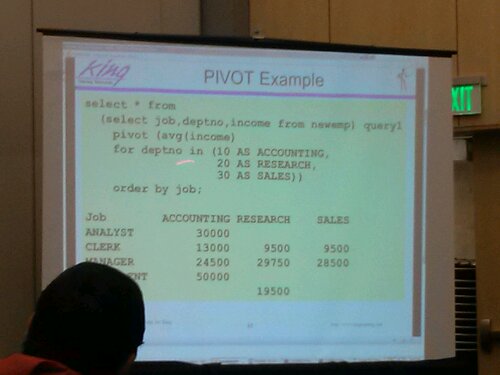
SQL PIVOT Example

SQL PIVOT Example

Example of UNPIVOT

Example of UNPIVOT

Another cool SQL Function: Nth Value

Another cool SQL Function: Nth Value

All neat options I did not really know about.

Next up was the keynote speech by Mogens Norgaard from Denmark. Mogens is an ACE Director, CEO of his own consulting firm, and a brew master. Interesting guy.

He showed up in his bathrobe to talk to us all about how the smartphone is taking over  the world and all the cool apps you could build (and some he has built).

Mogens Norgaard in his keynote best.

Mogens Norgaard in his keynote best.

Next was my turn – my first session of the conference – 5 Ways to Make Data Modeling Fun (based on a blog post).

I was pleasantly surprised that I had 40-50 people attend and most stayed for the whole talk. It was a good, interactive session. My good buddy Jon Arnold assisted me in administering some of the activities. It was great fun getting the attendees to actually collaborate on activities during a session.

Great participant collaboration during my talk

Great participant collaboration during my talk

As promised, I did give out prizes for some of the activities (all branded Data Warrior LLC stuff).

Next was the ACE Director networking lunch where they put our names on tables so people could sit with us to ask questions (if they wanted too).

Networking Lunch

Networking Lunch

After lunch we some vendor sessions (which I skipped) and several panel discussions. These included the Women in Technology Panel and an Oracle Career Roundtable.

Women in Technology Panel
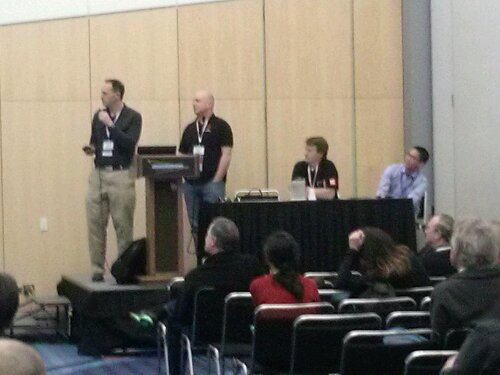
Women in Technology Panel

Oracle Careers Roundtable

Oracle Careers Roundtable

Anyone notice that the Women in Tech had one male on the panel but the Oracle Career panel had no women? Just sayin’ folks…

Next I sat in for part of a session on Oralce TimesTem database for real-time BI. It turned out to be the same stuff I heard at Oracle Open World so I did not stay.

Last for my day at RMOUG was my joint session with Stewart Bryson on Data Vault and OBIEE. Unfortunately due to the late slot (5:15 PM) we had a very low turn out. 😦 But is was a good session as I discovered all the things Stewart learned trying to use the data vault model for virtualizing the data mart layer (in OBIEE). It was all very good and reinforced my belief that Data Vault is a great way to model an EDW and that non-data vault people could understand it and apply it to dimensional modeling (or that Stewart is really exceptional).

Adios for now.

Kent

P.S. Forgot to mention again that I will be conducting another morning Chi Gung class at & AM above the registration area. Please join!


Rocky Mountain High and Some Chi Gung

Are you ready?

Are you coming?

The annual Rocky Mountain Oracle Users Group Training Days kicks off next Monday, February 11 at the Denver Convention Center. I can hardly wait! I love the beautiful surroundings and vibe of Denver and the mountains. It is a great place to hang out, relax, and sharpen your skills.

I will be there attending sessions, networking with some old friends, and doing three presentations. Here they are:

Five Ways to Make Data Modeling Fun Tuesday, 11:15 – 12:15

Using OBIEE and Data Vault to Virtualize Your BI Environment: An Agile Approach Tuesday, 5:15 – 6:15 PM

Top 10 Cool Features in Oracle SQL Developer Data Modeler Wednesday 2:45 – 3:45 PM

In addition to these officially scheduled sessions, I will be conducting  Morning Chi Gung sessions at 7 Am both Tuesday and Wednesday morning for those interested. Not sure yet where we will gather for this but probably in the Convention Center somewhere. (Keep an eye on my twitter stream @KentGraziano for details once I am on site next Monday).

The Chi Gung sessions are staring to be a traditon with me at various Oracle user events, so please come and join our growing tribe. If you are not sure what Chi Gung is, check out my post from last summer for a video introduction. For those of us coming from lower altitude, these morning sessions should help us adjust a little easier. Since the air is a bit thinner in Denver, learning to breathe deeply will be a useful skill. 🙂

If you are signed up and planning to attend, I look forward to meeting up with you. If not, get signed up soon and get yourself to Denver to enjoy a little Rocky Mountain high with 1,000 of the brightest Oracle minds in the world.

See ya!

Kent


Data Vault vs.The World (3 of 3)

So far in this series I have compared and contrasted the Data Vault approach to that of  using a replicated ODS or a dimensional Kimball-style structure for an enterprise data warehouse repository. Let me thank everyone who has replied or commented for taking these posts as they were intended, keeping the conversation professional and not starting any flame wars. 🙂

So to close out the thread I must of course discuss using classic Inmon-style CIF (Corporate Information Factory) approach. Many of you may also think of this as a 3NF EDW approach.

To start it should be noted that I started my data warehouse career building 3NF data warehouses and applying Bill Inmon’s principles. Very shortly after I began learning about data warehousing I had the incredible privilege of getting to not only meet Mr. Inmon and learn from him but I got to co-author a book (my first) with him. That book was The Data Model Resource Book. I got to work with Bill on the data warehouse chapters and because of that experience became well versed in his theories and principles. For many years I even gave talks at user group events about how to convert an enterprise data model to an enterprise data warehouse model.

So how does this approach work? Basically you do some moderate denormalization of the source system model (where it is not already denormalized) and add a snapshot date to all the primary keys (to track changes over time). This of course is an oversimplification – there are a number of denormaliztion techniques that could be used in build a data warehouse using Bill’s original thesis.

Additionally this approach (CIF or even DW 2.0) calls for then building dimensional data marts on top of that EDW (along with other reporting structures as needed). Risks here are similar to those mentioned in the previous posts.

The primary one being that the resulting EDW data structure is usually pretty tightly coupled to the OLTP model so the risk of reworking and reloading data is very high as the OLTP structure changes over time. This of course would have impacts downstream to the dimensional models, reports, and dependent extracts.

The addition of snapshot dates to all the PKs in this style data warehouse model also adds quite a bit of complexity to the load and query logic as the dates cascade down through parent-child-child-type relationships. Getting data out ends up needing lots of nested Max(Date) sorts of sub-queries. Miss a sub-query or get it wrong and you get the wrong data. Overall a fairly fragile architecture in the long run.

Also like the dimensional approach, I have encountered few teams that have been successful trying to implement this style of data warehouse in an incremental or agile fashion. My bad luck? Maybe…

The loosely coupled Data Vault data model mitigates these risks and also allows for agile deployment.

As discussed in the previous posts, the data model for a Data Vault based data warehouse is based on business keys and processes rather than the model of any one source system. The approach was specifically developed to mitigate the risks and struggles that were evident in the traditional approaches to data warehousing, including what we all considered the Inmon approach.

As I mentioned earlier I got to interact with Bill Inmon while we worked on a book. The interaction did not stop there. I have had many discussions over the years with Bill on many topics related to data warehousing, which of course includes talking about Data Vault. Both Dan and I talked with Bill about the ideas in the Data Vault approach. I spent a number of lunches telling him about my real-world experience with the approach and how it compared to his original approach (since I had done both). There were both overlaps and differences. Initially, Bill simply agreed it sounded like a reasonable approach (which was a relief to me!).

Over a period of time, many conversations with many people, study, and research, we actually won Bill Inmon over and got his endorsement for Data Vault. In June of 2007,  Bill Inmon stated for the record: 

The Data Vault is the optimal choice for modeling the EDW in the DW 2.0 framework.

So if Bill Inmon agrees that Data Vault is a better approach for modeling an enterprise data warehouse, why would anyone keep using his old methods and not at least consider learning more about Data Vault?

Something to think about, eh?

I hope you enjoyed this little series about Data Vault and will keep it in mind as you get into your new data warehouse projects for 2013.

Kent

P.S. – if you are ready to learn more about Data Vault, check out the introductory paper on my White Papers page, or just go for broke and buy the Super Charge book.

Data Vault vs. The World (2 of 3)

In the first post of this series, I discussed advantages of using a Data Vault over a replicated ODS. In this post I am going to discuss Data Vault and the more classical approach of a Kimball-style dimensional (star schema) design.

To be clear upfront, I will be comparing using Data Vault to using dimensional for the enterprise data warehouse repository. Using star schemas for reporting data marts is not at issue (we use those in the data vault framework regularly).

I also want to recognize that there are some very expert architects out there who have had great success building Kimball-style EDWs and mitigated all the risks I am going to mention. Unfortunately, there are not enough to them to go around.  So for the rest of us, we might need an alternative approach…

When considering a Kimball-style approach, organizations often consider designing facts and dimensions to hold the operational data from one of their source systems. One downside to this approach is that to design optimal structures we would have to have a very solid understanding of all the types of questions the business needs to answer. Otherwise we risk not having the right fact tables designed to support the ever-changing needs of the business. So this tends to make it difficult to implement in an agile, iterative manner and can lead to the need for re-engineering. This is especially a risk with conformed dimensions. While adding new fact tables in an interative fashion is not a problem, having to redeign or rebuild a large conformed dimension could be big effort.

Additionally there may be requirements to extract data for various other analysis. Dimensional models do not lend themselves well to all types of extracts. Not every query can be supported by cube-type designs – especially if the data is spread across multiple fact tables with varying levels of granularity.

With a Data Vault solution we can store all the data at an atomic level in a form that can easily be projected into dimensional views, 3NF ODS-style structures or just flat denormalized spreadsheet style extracts. This will allow us to be more agile in addressing the changing report and extract requirements than if we have to design new facts and dimensions, then write and test the ETL code to build them.

Plus the instantiated dimension model (which is highly denormalized) will simply take more space than a data vault model which is more normalized.

Using the dimensional approach, as the basis for the foundation layer of an enterprise data warehouse, there is also the risk pf having to redesign, drop and reload both facts and dimensions as the OLTP model evolves. That effort can be very expensive and take a lot of time.

With the Data Vault  it is much easier to evolve the warehouse model by simply adding new structures (Hubs, Links, Sats) to the model to absorb the changes.

Integrating other source systems can also be a challenge with dimensional models, especially in populating conformed dimensions as you have to account for all semantic and structural differences between the various systems before you load the data. this could mean a lot for cleansing and transforming the source data (which could jeopardize your ability to clearly trace data to the source.)

Data Vault avoids this issue by integrating around business keys (via Hubs) and allowing for apparently disparate data sets to be associated through the use of Same-As-Link tables to support dynamic equivalence mappings of the data sets from different sources. In agile terms, these structures can be built in a future sprint after the data is loaded and profiled. (As a side note, Same-As-Links are also very helpful for using your vault to do master data type work.)

Well, those are the primary issues I have run across. I am sure there are more, but this should be enough for now.

Can’t wait to hear your comments! Be sure to tweet this to your friends.

Later,

Kent

P.S. Stay tuned for #3 where I will discuss traditional Inmon 3NF-style data warehouse.

Data Vault vs. The World (1 of 3)

Okay, maybe not “the world” but is does sometimes seem like it.

Even though the Data Vault has been around for well over 10 years now, has multiple books, video, and tons of success stories,  I am constantly asked to compare and contrast Data Vault to approaches generally accepted in the industry.

What’s up with that?

When was the last time you got asked to justify using a star schema for your data warehouse project?

Or when was that expensive consulting firm even asked “so what data modeling technique do you recommend for our data warehouse?”

Oh…like never.

Such is the life of the “new guy.” (If you are new to Data Vault, read this first.)

So, over the next few posts, I am going to lay out some of the explanations and justifications I use when comparing Data Vault to other approaches to data warehousing.

The first contestant: Poor man’s ODS vs. Data Vault

This approach entails simply replicating the operational (OLTP) tables to another server for read only reporting. This could be used as a partial data warehouse solution using something like Oracle’s GoldenGate to support near real time operational reporting that would minimize impact on the operational system.

This solution, however, does not adequately support needs for dimensional analysis nor would it allow for tracking of changes to the data historical (beyond any temporal tracking inherent in the OLTP data model).

A big risk of this approach is that as the OLTP structures continue to morph and change over time, reports and other extracts that access the changed structures would of course break as soon as the change was replicated to the ODS.

How does Data Vault handle this?

Data Vault avoids these problems by using structures that are not tightly coupled to any one source system. So as the source systems change we simply add Satellite and Link structures as needed.  In the Data Vault methodology we do not drop any existing structures so reports will continue to work until we can properly rewrite them to take advantage of the new structure.  If there is totally new data added to a source, we would probably end up adding new Hubs as well.

An additional advantage is that because Data Vault uses this loosely coupled approach we can load data from multiple sources. If we replicate specific OLTP structures, we would not be able to easily integrate other source system feeds – we would have to build another repository to do the integration (which would likely entail duplicating quite a bit of the data).

Don’t get me wrong, there is nothing wrong with using replication tools to build real time operational data stores.

In fact it is an excellent solution to getting your operational reporting offloaded from the main production server.

It is a tried and true solution – for a specific problem.

It is however, not the right solution if you are building an enterprise data warehouse and need to integrate multiple sources or need to report on changes to your data over time.

So let’s use the right tool for the right job.

Data Vault is newer, better tool.

In the next two posts I will compare Data Vault to the Kimball-style dimensional approach (part 2 of 3) and then to Inmon-style 3NF (part 3 of 3).

Stay tuned.

Kent

P.S. Be sure to sign up to follow my blog so you don’t miss the next round of Data Vault vs. The World.


Post Navigation