The Data Warrior

Changing the world, one data model at a time. How can I help you?

Happiness is not the absence of conflict

Happiness is not the absence of conflict but the ability to cope with it

–Annon

The ability to cope with conflict is part of having a warrior spirit!

Have a great day!

Kent

The Oracle Data Warrior

Oracle OpenWorld 2013: Recap Part 2

For those that missed this year’s event, here is another little recap complete with links to all the relevant details.

Thanks to the folks at Oracle for giving me permission to re-blog this post! ( I apologize in advance for some of the funky formatting)

ORACLE OPENWORLD 2013 HIGHLIGHTS


OOW SESSION ANNOUNCEMENTS – TECHNOLOGY AND HARDWARE UPDAT

  • Major Announcements: The SPARC M5-32 and Oracle SuperCluster M6-32 Oracle’s new systems dramatically redefine the price/performance equation in the high-end server market, offering customers entry-level price/performance, while maintaining extreme performance and the highest levels of availability. SPARC M6-32 servers with up to 32 terabytes of memory and up to 384 processor cores can run entire applications and databases in-memory to deliver unprecedented performance. Oracle SuperCluster M6-32 is Oracle’s fastest and most scalable engineered system and integrates SPARC M6-32 servers with Oracle Exadata Storage Servers optimized for Oracle Database performance. Read the Press Release: http://www.oracle.com/us/corporate/press/2016809
  • Oracle Big Data Appliance Incorporating Big Data into your enterprise can result in opportunities to transform your business, but the growing volume and complexity of big data can also pose a challenge. Through Oracle’s Unified Information Architecture, customers can easily and cost-effectively integrate Hadoop and NoSQL platforms with their data warehousing and business analytics solutions to maximize the value of big data. While Hadoop provides a scalable foundation for Big Data projects, the lack of built-in security has been an obstacle for many enterprises. To meet this need, Oracle has enhanced the Oracle Big Data Appliance to include enterprise-class security capabilities for Hadoop. Oracle is also announcing new versions of Oracle Big Data Connectors and Oracle NoSQL Database, which provide enhanced functionality, performance, and scalability. Read the Press Release: http://www.oracle.com/us/corporate/press/2020714
  • Oracle Exalytics T5-8 Scales Up to Deliver Customers with Analytic Insights: With the ever-increasing volume, scale and scope of business data, organizations need to quickly turn high-velocity data into actionable insights to gain a competitive edge. To extract the maximum value from this very dynamic data, organizations must process data faster and take timely action. Oracle Exalytics In-Memory MachineT5-8, the new engineered system with 4TB of memory per machine, delivers extreme performance for business intelligence (BI) and enterprise performance management (EPM) applications, helping organizations drive better efficiency by speeding answers to complex business scenarios. Read the Press Release: http://www.oracle.com/us/corporate/press/2021056
  • Oracle DB Backup Logging Recovery Appliance Unveiled at OpenWorld 2013 in San Francisco, Oracle DB Backup Logging Recovery Appliance answers the demand for total data protection without the loss of application performance or availability. The new product helps business users prevent data loss, avoid long restore downtimes, and protect against system slowdowns during backups. Read the Press Release Watch Larry Ellison Announces Oracle DBLRA Get the Executive Brief (PDF)
  • Oracle DB In-Memory Option for Oracle DB 12c Discovering meaningful insight from a mountain of information is the core Big Data challenge. The new Oracle Database In-Memory Option for Oracle Database 12c dramatically accelerates database performance, enabling new business insights, real-time decision-making, and much faster online transaction processing response times without changes to existing applications. Using the Oracle Database In-Memory Option, decades of IT investments become immediately more valuable. Read the Press Release: http://www.oracle.com/us/corporate/press/2020717
  • Enhanced In-Memory Applications with New Oracle DB In-Memory Option Speed and agility define today’s global economy. Traditional transactional systems generate incredible amounts of useful data but require batch, manual, or separate system processing to analyze and immediately present data visually for business decisions. Processing power has improved significantly and can speed the performance of business critical applications, but has not been leveraged to generate complex data analysis in real-time to make sound decisions and solve critical business problems. Read the Press Release: http://www.oracle.com/us/corporate/press/2020674
  • Oracle Marketing Cloud: New, Fully Integrated Digital and Social Solution Managing digital marketing and social efforts separately make it difficult for marketers to deliver a compelling and consistent experience at every touch point. To address this challenge, Oracle Marketing Cloud announced further integration between Oracle Eloqua and Oracle Social Relationship Management (SRM) to deliver the industry’s most comprehensive, scalable, and integrated modern marketing solution. The enhanced profiling, social analytics, tracking, publishing, and custom targeting capabilities will help modern marketers better understand, target, engage, convert, and analyze target audiences. Read the Press Release: http://www.oracle.com/us/corporate/press/2020673
  1. New Cloud Services
  • Database as a Service, Java as a Service, and Infrastructure as a Service: Oracle powers the top 10 SaaS providers, thousands of SaaS applications, and many of the world’s private clouds. All of these rely on a robust cloud platform that provides applications with rich functionality with high performance, elasticity, availability and security. To support a wider variety of workloads, Oracle introduced new Oracle Cloud services: Oracle Database as a Service, Oracle Java as a Service, and Oracle Infrastructure as a Service. http://www.oracle.com/us/corporate/press/2021412
  • 10 New Services to Expand the Industry’s Most Comprehensive Cloud Portfolio: As organizations of all sizes move more of their information systems to the cloud, Oracle is expanding the number of Oracle Cloud services to strengthen its position as the industry’s most comprehensive public cloud. Oracle Cloud offers a broad range of modern, functionally rich and integrated services running in a secure, enterprise and standards-based cloud platform. With new Application, Platform, and Infrastructure Services announced today, Oracle is helping customers and partners further capitalize on the power of cloud computing.  http://www.oracle.com/us/corporate/press/2021083
  • New Global Cloud Marketplace Gives Partners an Opportunity to Reach Oracle Customers: With the proliferation of cloud, mobile, and social technologies, organizations want easy access to innovative, trusted business applications. To meet this demand from customers and create new opportunities for partners, Oracle has introduced the Oracle Cloud Marketplace. Featuring more than 100 business applications developed by Oracle partners, the Oracle Cloud Marketplace enables Oracle Cloud customers to easily browse, evaluate, and buy trusted business applications. Leveraging Oracle Cloud Platform Services, Oracle partners can quickly build applications, extend, and integrate with Oracle SaaS applications, and publish their applications on the Oracle Cloud Marketplace to reach Oracle customers. http://www.oracle.com/us/corporate/press/2021085
  • Roadmap for Nimbula Director and OpenStack API Integration with Oracle Exalogic Elastic Cloud: The integration of Nimbula Director into Oracle Exalogic Elastic Cloud will enable customers and service providers to deploy an open, standards-based Infrastructure as a Service (IaaS) foundation with proven breakthrough application performance for Java, Oracle Fusion Middleware, and Oracle Applications. This highly scalable, self-healing and resilient cloud infrastructure will scale from a single Oracle Exalogic rack to thousands of virtual machines and many racks. Leveraging OpenStack and other open industry standards, Oracle Exalogic will deliver a high performance cloud solution that more seamlessly integrates into customers’ existing data centers. http://www.oracle.com/us/corporate/press/2021286
  • Oracle Simplifies Enterprise Mobile Application Development with Mobile Platform in the Cloud: As business demands have increased and the workforce has become more mobile, the need for enterprises to ensure users are connected via any device to their enterprise applications, at any time has become more critical. Oracle’s Mobile Platform addresses this challenge by simplifying application development and allowing developers to securely create and deliver more compelling user experiences. By simplifying this process, enterprises can maximize IT investments and lower application development costs http://www.oracle.com/us/corporate/press/2021060
  • Oracle Billing and Revenue Management Cloud Service Helps Enterprises Deliver and Monetize Innovative New Product Offerings and Capture Recurring Revenue Streams: Oracle unveiled Oracle Billing and Revenue Management Cloud Service to provide enterprises with a robust and highly scalable billing solution to capture recurring revenues from new digital services. This advanced cloud billing service is suited for multiple industries including financial services, media, and communications; and offers sophisticated subscription management and rating using any combination of measurable metrics including usage, time of day, length of use, delivery method, device, medium, volume, and the like http://www.oracle.com/us/corporate/press/2021078
  • Oracle Exalytics Enables Customers Worldwide to Quickly Uncover Business Insights: Organizations that derive actionable, real-time insights from unified business data can capitalize on innovation and efficiencies that deliver a competitive edge. Built using industry-standard hardware, market-leading business intelligence software and in-memory database technology, Oracle Exalytics In-Memory Machine is an engineered system that delivers answers to business questions with unmatched speed, intelligence and simplicity. Customers around the world continue to rapidly adopt Oracle Exalytics to uncover their business answers, faster. http://www.oracle.com/us/corporate/press/2021058
  • Oracle Empowers Modern Workforce with Cutting Edge Mobile Applications Across Entire Enterprise Application Portfolio: Organizations across all industries are increasingly looking for robust and powerful applications that are tailored to mobile devices and can provide their people with anywhere, anytime access to enterprise information. To give the mobile workforce access to mission- critical information at their fingertips, Oracle has developed a wide range of cutting-edge mobile capabilities. By giving organizations a huge choice of out-of-the-box mobile applications, as well as the option of leveraging Oracle’s Mobile platform to develop their own mobile applications, Oracle is empowering the mobile workforce for organizations across the world. http://www.oracle.com/us/corporate/press/2021070
  • Oracle Achieves New World Record with SPECjEnterprise2010 Benchmark in Virtualized Environment: Further demonstrating extreme performance, Oracle WebLogic Server and Oracle Database running virtualized on a single Oracle SPARC T5-8 server have achieved a new world record result. The SPECjEnterprise2010 benchmark beats IBM’s Power7+ benchmark, also running on a single virtualized server. http://www.oracle.com/us/corporate/press/2021054
  • Oracle HCM Cloud and Oracle Talent Management Cloud Updates Advance Its Vision for the Future of Work: To help manage the complex and evolving role of HR, businesses are turning to modern HR technologies as a way to develop an efficient and productive workforce that positively impacts the bottom line. Oracle announced significant enhancements to the world’s most complete cloud-enabled HCM solution including core HR, benefits, payroll, recruiting, performance management, and learning. Updates to Oracle Human Capital Management (HCM) Cloud and Oracle Talent Management Cloud support the changing workplace by delivering a more interactive, social and mobile employee experience across our global workforce and talent solutions for global HR, workforce rewards and optimization, recruiting, talent management, performance management, succession planning, and learning management. http://www.oracle.com/us/corporate/press/2020966

OOW SESSION ANNOUNCEMENTS – JDE

General Availability of JDE Release 9.1 Update 2

  • Featuring innovative solutions that focus on Mobility, Industry, and User Productivity
  • New smartphone and tablet applications deliver role based solutions to meet the needs of mobile users
  • Update 2 continues to deliver many enhancements that provide deep vertical industry solutions focused on manufacturing and distribution, consumer goods, projects and service, and asset intensive industries
  • Usability and productivity enhancements are found throughout the applications and business processes such as new capabilities to support automation of the voucher match process

JDE Release 9.1 Update 2 Enhancements

  • Mobile Service Time Entry
  • Speed Case Entry Tablet application
  • Warehouse Management Tablet application
  • Warehouse Management One View Reporting
  • Real Estate Management Unit Attributes
  • Health and Safety Incident Management – previously announced
  • Automated Inventory to G/L Reconciliation
  • One View drill back capabilities to EnterpriseOne Applications

Oracle Product Catalog for JDE

  • Includes all enhancements for JDE. Dynamic, online search tool that enables you to obtain release net change information
  • You can customize the search by release, product, feature, any word, or compare changes between releases
  • You can export the output to csv, email, html, pdf, or rtf formats
  • Access the product catalog from the link:

https://apex.oracle.com/pls/apex/f?p=24153:99:338179293643601:TAB:NO:::

Oracle Technical Catalog

  • Online search tool across releases. You can search by release, functional product areas, object type and system codes, or compare changes between releases
  • Oracle Technical Catalog replaces the JD Edwards Applications Programmer’s Guide as the single source to find technical changes for the JD Edwards products
  • The Applications Programmer’s Guide is now obsolete and will no longer be published. Access the Oracle Technical Catalog from either of the following links:

–     https://apex.oracle.com/pls/apex/f?p=50180

–     http://upgradejde.com/ site by clicking the Resources button

Other JDE Information Resources

–     http://www.oracle.com/us/products/applications/jd-edwards-enterpriseone/overview/index.html

  • JDE Upgrade Resources

–     http://www.upgradejde.com/

  • 9.1 Update 2 application enhancement details

–     https://apex.oracle.com/pls/apex/f?p=24153:33:103638780468911::NO::P33_ID:249050806491876927463471531308193737984

  • JDE Customer Success Videos

–     http://medianetwork.oracle.com/media/categories/applications/821507647001

OOW SESSION ANNOUNCEMENTS – WEBCENTER

WebCenter Content 11.1.1.8

  • New User Interface
    • Simple & Fast
  1. Single Page App – faster then current UI
  2. New Document Library views
  3. Type-Ahead search & filtering, integrated viewers
  • Compelling
  1. Provides the best capabilities in the industry
  2. Modeled after consumer web design
  • Architectural Improvements
  1. Detached UI app in front of Content Server
  2. New Enterprise Libraries
  • Mobile
    • Supports B.Y.O.D. Initiatives
    • Knowledge-worker focused apps
    • iOS/Android apps
    • Automated content synchronization
    • Supports business process solutions
  • Automated Capture and Forms Recognition
    • What’s New
  1. Web-based scan/index/admin user interface
  2. Improved data recognition and extraction engine (OCR, handprint and table extraction)
  • Benefits
  1. Standard deployment, administration and language support model
  2. Improved cross-browser support
  3. Simplified support for distributed capture of documents into WebCenter Content
WE HOPE TO SEE YOU AT OOW 2014!!

Warrior Quote of the Day

Words to live by – warrior or not:

‘Do nothing which is of no use.’ ~Miyamoto Musashi

— Leo Babauta (@zen_habits) November 9, 2013

East Coast Oracle Users Conference (#ECOracle13) Review

This week I did a little travel and went to Durham, North Carolina to present at the 2013 East Coast Oracle Users Conference (aka ECO). While I have been aware of this event for over 20 years, it is the first time I have attended.

It was worth the trip. (Thanks to Jeff Smith at Oracle for alerting me to the event and encouraging me to submit). He actually sent me, Danny and Sarah (The EPM Queen). It was great to have members of the ODTUG clan together.

The gang of three - ODTUGers at ECO13 thanks to That Jeff Smith guy. Yea - he sent us!

The gang of three – ODTUGers at ECO13 thanks to That Jeff Smith guy. Yea – he sent us!

Overall a well run event held at the Sheraton Imperial Hotel and Conference Center. It drew over 300 attendees and a large list of Oracle ACE and ACE Directors were there to present to a crowd very eager to learn and network.

Fun and Games: The Keynote

Our opening keynote from Steven Feuerstein (inventor of the PL/SQL Challenge)  was a fun take on different types of therapy and how they might be applied to software developers.
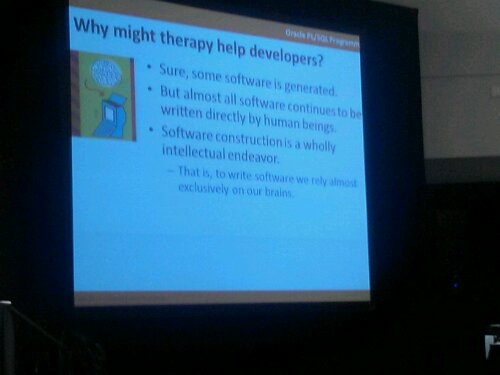
PL/SQL Evangelist Steven Feuerstein discusses Coding Therapy for Software Developers

PL/SQL Evangelist Steven Feuerstein discusses Coding Therapy for Software Developers

His discussed the use of:

  • Game therapy (try out mastermind or setgame.com)
  • Dream Therapy
  • Confessional Therapy
  • Shock Therapy
  • Couples Therapy
    • For DBA & Developers
    • For Developers & Their Managers

It was a fun, light way to start the conference with some very valuable advice.

Heavy Duty DBA-type Tuning Talks

Oracle ACE Director, author, and trainer Craig Shallahamer did two deep dive tuning sessions that I attended. In the first one, Introduction to Time-based Performance Analysis: Stop the Guessing, Craig gave us his four point framework for Holistic Performance Analysis. The points were:

  1. The Three Circles to consider (OS, Database, Application)
  2. Be Quantitative (i.e., trust the numbers not a hunch)
  3. Serialization is death, Parallel is life
  4. Tell a story (make the explanation of the issue understandable to managers)

With that he got into all sorts of v$ view stuff that went mostly over my head. Needless to say I will have to download the slides from his site (orapub.com) and give them to someone more attuned to this kind of tuning than I!

Oracle ACE Director, Craig Shallahamer discusses low level details for understanding Oracle CPU consumption

Oracle ACE Director, Craig Shallahamer discusses low level details for understanding Oracle CPU consumption

The second presentation Craig gave was called Understanding Oracle CPU Consumption: The Missing Link. Again lots of views and some Linux OS utilities (e.g., perf) and lots of numbers were displayed and discussed to try to ferret out how to determine what Oracle functions were actually taking up CPU time.

Even though I don’t really understand a lot of this (hey, I am a data modeler, not a dba right?) I like to go to sessions like this as I enjoy listening to smart people talk passionately about the things they do, and I figure I might retain just enough to point someone else in the right direction in the future, even if it is only to give them a copy of these slides!

Lovely Southern Style Lunch

ECO had one of the nicest little lunch buffets I have eaten in a while. Very simple southern food that included cole slaw, potato salad, baked chicken, fried chicken, pulled port (with N. Carolina bbq sauce), hush puppies and apple cobbler. (I did not say it was a light lunch right?)

I love all kinds of BBQ and the pulled pork did not disappoint. I do not usually like fried chicken but figured I should try it and was pleasantly surprised. Crisp and moist. Very nice.
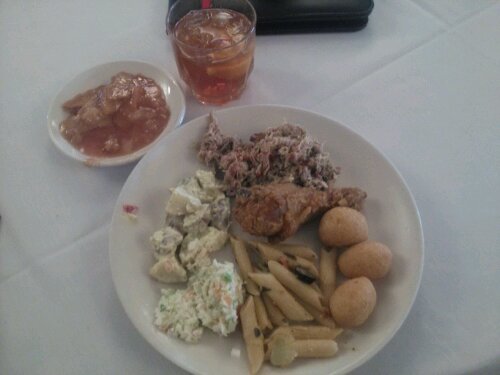
Traditional Southern Fare for Lunch

Traditional Southern Fare for Lunch

My 1st Session – Making Data Modeling Fun

I had the best turnout ever for this topic with over 40 people in the session most of whom were game to try my gamification of data model review sessions.

Session attendees developing Haiku poems based on a Data Model

Session attendees developing Haiku poems based on a Data Model

One of the tasks was to translate relationship sentences and model descriptions into Haiku (or another form). There were prizes as an incentive to play along.

Some of the prizes for participants at my talk

Some of the prizes for participants at my talk

The winner by general acclamation was Edie Waite from Raleigh, NC with this little limerick:

There once was a country named France
Which had many regions for dance
The locations they chose to dance on their toes
Made employees all look askance.

The data model we used had the entities: Country, Region, Employee, Locations, and a few others.

Another Haiku from Sarah Zumbrum (a noted non-data modeler) went like this:

More than one region
Can reside in a country
Like the USA
The session was really a lot of fun thanks to everyone being open minded and being willing to try some unconventional approaches to gathering data model requirements. (There was one other Haiku in French which I will add as soon as the author sends it to me!)

ECO 13 – Day 2

Keynote today was about eBusiness suite stuff. I sat there after breakfast mostly not listening as I started to put this blog post together.

Then I did my 2nd talk.

Agile Data Warehouse Modeling

I had a somewhat disappointing turnout (only 5 people, sigh) but it was a great exchange with those 5 people. We had a very good discussion about applying agile techniques to building a data warehouse and I was able to introduce them to some of the details of Data Vault Data Modeling. None of them knew much about data vault, but some had heard the term.

One attendee did tell me he was skeptical about the approach when he came in as he was a traditional Kimball dimensional data warehouse guy. But after the session he was willing to concede there was some merit and ideas he had not seen before and he was going to take those into consideration as he embarked on a new phase of his project where there were some complex problems to solve. He could see that data vault might just help.

Really can’t ask for more than that!

Embedded Analytics

So my last session for the event was to attend Craig Warman’s talk on embedded analytics. It was a good discussion about how BI and analytics have evolved, Craig presented a simple maturity model as part of the talk:

Level 0: BI reporting and analytic applications are completely seperate from other applications
Level 1: Gateway Analytics – Operational applications have a report tab or menu item to launch the BI reporting tool interface. Maybe there is a login pass through.
Level 2: Inline Analytics – at this level, the analytics and BI tool has been incorporated into the operational application interface to the point it has the same look and feel and you can’t tell it is a separate product or tool. This where many organizations are today.
Level 3: Infused Analytics – this is the goal. At this level the analytics are truly part of the application and provide core functionality. Examples of this are the recommendations you get on Amazon as you check out or the movie suggestions you get on Netflix based on your prior movie choices. If the analytic pieces were removed the application would not function correctly.
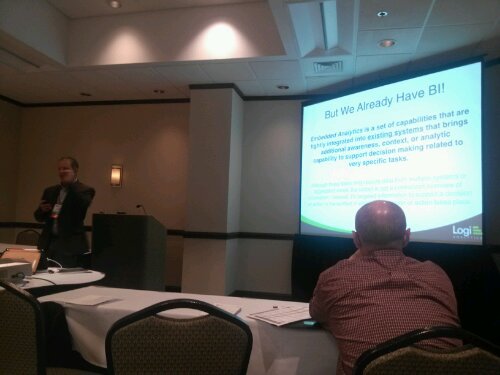
Craig Warman (ECO13 conference chair) talks about what embedded analytics is (and is not)

Craig Warman (ECO13 conference chair) talks about what embedded analytics is (and is not)

Well that’s it for this conference.

Put ECO on your radar for 2014.

See you around.

Kent

P.S. Next conference on my agenda is RMOUG TD 2014. Let me know if you will be there.

Agile Data Warehouse Modeling: How to Build a Virtual Type 2 Slowly Changing Dimension

One of the ongoing complaints about many data warehouse projects is that they take too long to delivery. This is one of the main reasons that many of us have tried to adopt methods and techniques (like SCRUM) from the agile software world to improve our ability to deliver data warehouse components more quickly.

So, what activity takes the bulk of development time in a data warehouse project?

Writing (and testing) the ETL code to move and transform the data can take up to 80% of the project resources and time.

So if we can eliminate, or at least curtail, some of the ETL work, we can deliver useful data to the end user faster.

One way to do that would be to virtualize the data marts.

For several years Dan Linstedt and I have discussed the idea of building virtual data marts on top of a Data Vault modeled EDW.

In the last few years I have floated the idea among the Oracle community. Fellow Oracle ACE Stewart Bryson and I even created a presentation this year (for #RMOUG and #KScope13) on how to do this using the Business Model (meta-layer) in OBIEE (It worked great!).

While doing this with a BI tool is one approach, I like to be able to prototype the solution first using Oracle views (that I build in SQL Developer Data Modeler of course).

The approach to modeling a Type 1 SCD this way is very straight forward.

How to do this easily for a Type 2 SCD has evaded me for years, until now.

Building a Virtual Type 2 SCD (VSCD2)

So how to create a virtual type 2 dimension (that is “Kimball compliant” ) on a Data Vault when you have multiple Satellites on one Hub?

(NOTE: the next part assumes you understand Data Vault Data Modeling. if you don’t, start by reading my free white paper, but better still go buy the Data Vault book on LearnDataVault.com)

Here is how:

Build an insert only PIT (Point-in-Time) table that keeps history. This is sometimes referred to as a historicized PIT tables.  (see the Super Charge book for an explanation of the types of PIT tables)

Add a surrogate Primary Key (PK) to the table. The PK of the PIT table will then serve as the PK for the virtual dimension. This meets the standard for classical star schema design to have a surrogate key on Type 2 SCDs.

To build the VSCD2 you now simply create a view that uses the PIT table to join the Hub and all the Satellites together. Here is an example:

Create view Dim2_Customer (Customer_key, Customer_Number, Customer_Name, Customer_Address, Load_DTS)
as
Select sat_pit.pit_seq, hub.customer_num, sat_1.name, sat_2.address, sat_pit.load_dts
from HUB_CUST hub,        
          SAT_CUST_PIT sat_pit,        
          SAT_CUST_NAME sat_1,        
          SAT_CUST_ADDR sat_2
where  hub.CSID = sat_pit.CSID           
    and hub.CSID = sat_1.CSID           
    and hub.CSID = sat_2.CSID           
    and sat_pit.NAME_LOAD_DTS = sat_1.LOAD_DTS           
    and sat_pit.ADDRESS_LOAD_DTS = sat_2.LOAD_DTS 
 

Benefits of a VSCD2

  1. We can now rapidly demonstrate the contents of a type 2 dim prior to ETL programming
  2. With using PIT tables we don’t need the Load End DTS on the Sats so the Sats become insert only as well (simpler loads, no update pass required)
  3. Another by product is the Sat is now also Hadoop compliant (again insert only)
  4. Since the nullable Load End DTS is not needed, you can now more easily partition the Sat table by Hub Id and Load DTS.

Objections

The main objection to this approach is that the virtual dimension will perform very poorly. While this may be true for very high volumes, or on poorly tuned or resourced databases, I maintain that with today’s evolving hardware appliances  (e.g., Exadata, Exalogic) and the advent of in memory databases, these concerns will soon be a thing of the past.

UPDATE 26-May-2018  – Now 5 years later I have successfully done the above on Oracle. But now we also have Snowflake elastic cloud data warehouse where all the prior constraints are indeed eliminated. With Snowflake you can now easily chose to instantly add compute power if the view is too slow or do the work and processing to materialize the view. (end update)

Worst case, after you have validated the data with your users, you can always turn it into a materialized view or a physical table if you must.

So what do you think? Have you ever tried something like this? Let me know in the comments.

Get virtual, get agile!

Kent

The Data Warrior

P.S. I am giving a talk on Agile Data Warehouse Modeling at the East Coast Oracle Conference this week. If you are there, look me up and we can discuss this post in person!

Post Navigation